Situationship vs Friends With Benefits vs Talking Stage: The Difference
Three labels people mix up all the time. Here is what each one means, how they differ, and which rules keep any of them from getting messy.
Dating · 5 min read ·
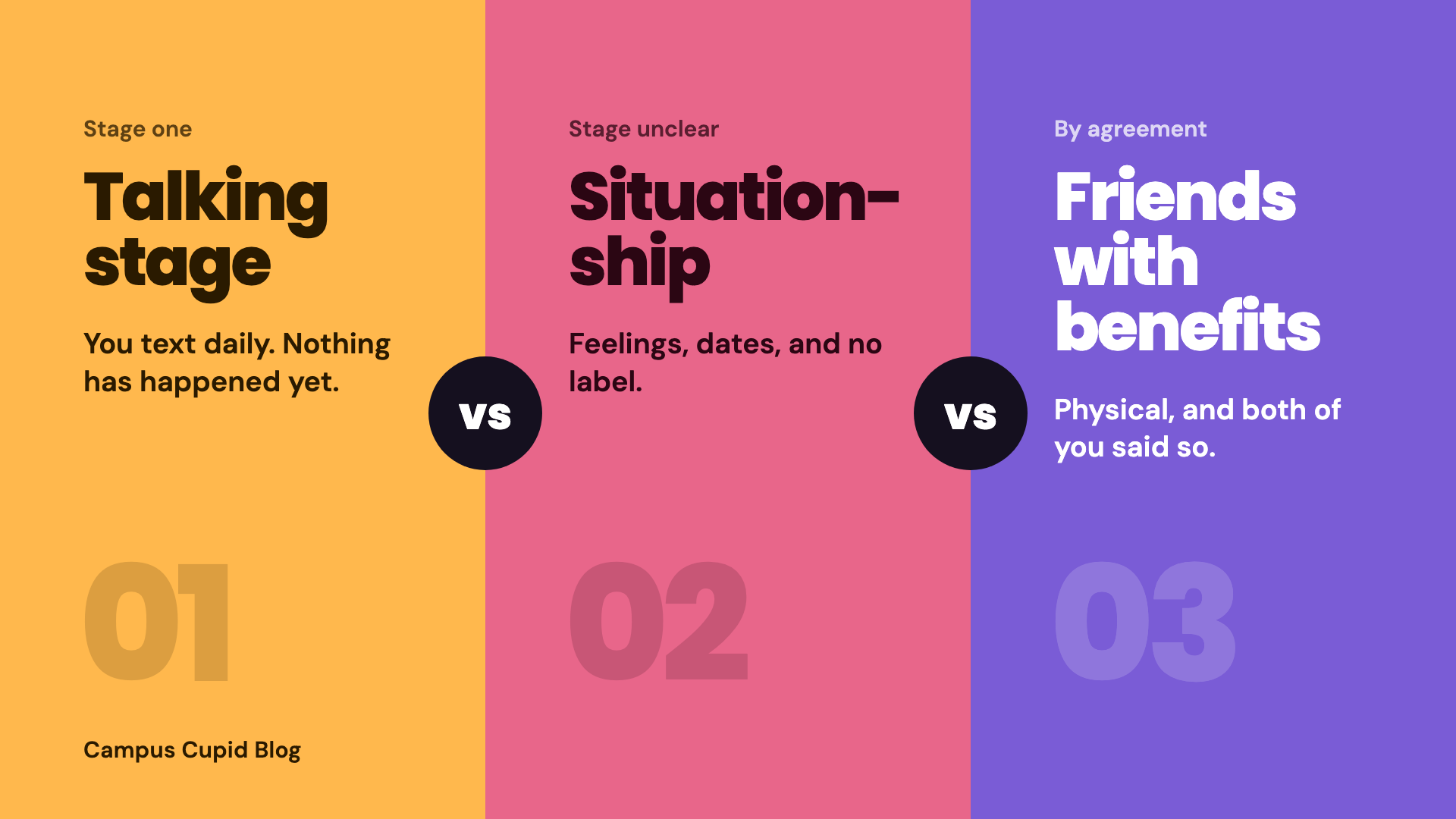
Three words for three different things
Talking stage, situationship and friends with benefits get used as if they mean the same thing. They do not, and mixing them up is how two people end up in the same connection with completely different expectations.
Here is the plain version of each.
The talking stage
You have matched, or met in class, and you are getting to know each other. You text most days. You may have been out once or twice. Nothing has been agreed, because it is too early to agree on anything.
What defines it: it is a beginning. It is supposed to go somewhere, either towards dating or towards nothing, within a few weeks.
The situationship
The talking stage that never ended. You behave like a couple in many ways, with regular time together, real feelings and often physical closeness, but there is no label and no conversation about what it is.
What defines it: ambiguity. The connection is real, and the terms are missing.
Friends with benefits
Two friends who have agreed to a physical relationship without a romantic one. The important word is agreed. Both people have said out loud what this is and what it is not.
What defines it: an explicit arrangement. There is clarity, even if there is no commitment.
Situationship vs friends with benefits
This is the comparison people search for most, and the difference comes down to one thing: whether you have talked about it.
- Friends with benefits has rules, even loose ones. You both know it is physical and not heading towards a relationship.
- A situationship has feelings and no rules. One or both of you may hope it becomes more.
Friends with benefits can turn into a situationship the moment one person catches feelings and does not say so.
Situationship vs talking stage
Time is the difference. A talking stage that lasts three weeks is a talking stage. One that lasts four months, with all the habits of a relationship, has become a situationship.
If you are not sure which one you are in, ask yourself whether anything has changed in the last month. If it has not, it is no longer a beginning.
Types of situationships
Most fall into one of a few patterns:
- The convenience one. You are in the same hostel, class or friend group, and it is easy.
- The long-distance one. Constant calls and texts, with no plan to be in the same city.
- The almost one. Both of you want a relationship and neither will say it first.
- The one-sided one. One person is invested, and the other is keeping options open.
The almost one is worth a conversation. The one-sided one usually is not worth the wait.
Rules that keep any of them from getting messy
Say what it is. Whichever of the three you are in, both people should be able to describe it the same way.
Agree on exclusivity. Do not assume. Ask.
Check in when something changes. If your feelings shift, say so early. It is kinder to both of you than hiding it.
Leave when the terms stop working. An arrangement that suited you in August does not have to suit you in December.
The simplest fix
Most of this confusion starts before the first date, when two people never say what they want. Being direct at the start, in your profile and in your first few conversations, filters out most of the mismatch.
Campus Cupid is a dating app for college students in India. It is open for pre-registration on Google Play.